EUR/USD Price Forecast - Eur steadies at $1.19 as weak Dollar Index and US data risks set the tone
Euro holds above $1.1880 support with DXY capped below 97.60, as markets brace for delayed US jobs data and CPI that could decide whether EUR/USD breaks $1.1965 toward the $1.20 zone | That's TradingNEWS
EUR/USD Price Forecast – Euro holds $1.19 as DXY slips toward 96.70 and NFP/CPI loom
Macro backdrop for EUR/USD – “Sell America” mood and structural dollar pressure
EUR/USD is trading around $1.1900–$1.1910 after a roughly 0.9% jump on Monday, and the move is being driven far more by a weaker US Dollar than by aggressive Euro strength. The US Dollar Index (DXY) has broken to its lowest levels since early 2022, slipping under 97.00 and stabilizing near $96.90, with a key short-term pivot at the 38.2% Fibonacci retracement around $96.83. At the same time, reports that Chinese regulators have asked domestic banks to limit US Treasury holdings signal a structural diversification away from dollar assets. Even a gradual rotation out of Treasuries from such a large reserve holder compresses demand for USD and supports upside in EUR/USD.
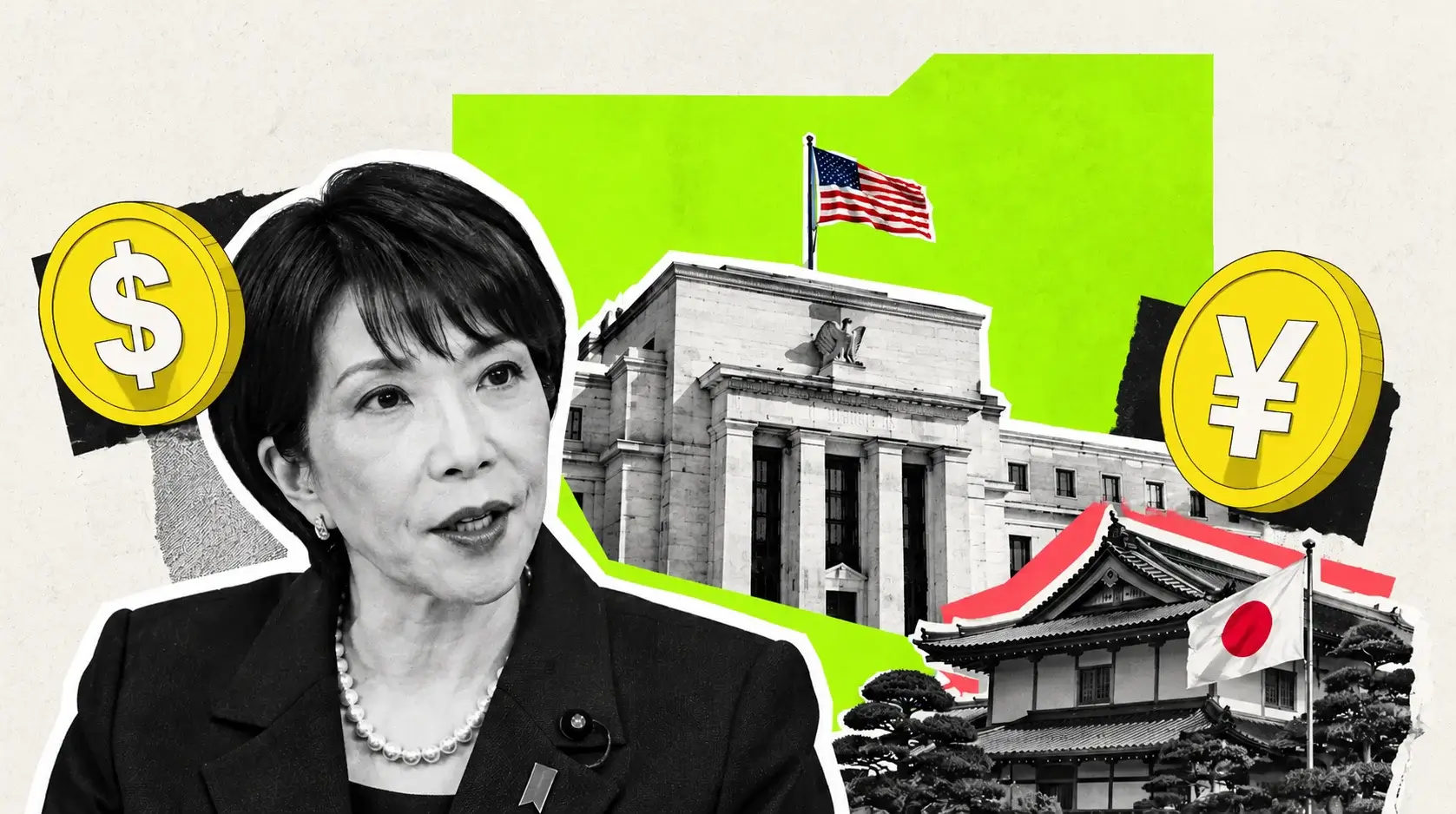
The political backdrop reinforces that pressure. In Japan, Sanae Takaichi’s landslide election win on February 8 removed a layer of uncertainty and launched the so-called “Takaichi trade”: more fiscal expansion, larger defense budgets and a stronger domestic risk bid. Capital has been rotating into Japanese equities and the Yen, eroding the dollar’s safe-haven premium. Parallel to that, easing tensions in the Middle East after US-Iran talks in Muscat, described publicly as “very good,” have pulled additional capital out of defensive USD positioning. When conflict risk fades, the dollar loses one of its core supports, and EUR/USD tends to benefit on the other side of that repricing.
Fed politics and rate expectations – Miran’s push for cuts underpins EUR/USD upside
On the monetary side, the debate inside the Federal Reserve is turning into a medium-term headwind for the greenback. Governor Stephen Miran has openly argued that current policy is “overly tight,” floating the idea of as much as 100 basis points of rate cuts in 2026. That kind of rhetoric, coming from a policymaker who recently shifted from the White House Council of Economic Advisers into the Fed, raises doubts about how insulated rate decisions really are from political pressure. Markets are already sensitive to any hint that the central bank could be leaned on to ease faster, and that undermines the dollar’s long-standing yield advantage.
If Miran’s view gains traction and the market starts to price a more aggressive easing path, DXY has room to slide further toward the 95.00 support area flagged in technical work. With DXY already pinned near $96.90 and capped below the 50-period moving average around $97.30 and the 100-period average near $97.60, the balance of risk is skewed toward additional softness rather than a sustained rebound. That backdrop favors a EUR/USD environment where dips are increasingly shallow and rallies toward $1.1965 and $1.2030 become more frequent.
Event risk cluster – delayed NFP and CPI as catalysts for EUR/USD volatility
The immediate calendar keeps the dollar in a “wait-and-react” posture. A delayed US Nonfarm Payrolls report, pushed back by the partial government shutdown, hits on Wednesday. The latest ADP release showed only 22,000 private jobs added in January, a soft print that already dented confidence in US labor momentum. Consensus now centers around a modest 55,000 jobs gain. Anything materially below that range would reinforce the Miran narrative that policy is too tight and push DXY toward the 96.34–95.00 band, giving EUR/USD room to extend above $1.1965.
Friday’s CPI release is the second trigger. A softer-than-expected inflation reading would validate the case for cuts and keep the dollar under pressure, reinforcing the current climb in EUR/USD above the $1.19 handle. A hotter print does the opposite: the market would quickly walk back rate-cut timing, DXY would have scope to re-test $97.60 resistance, and the pair could be forced back toward the $1.1850–$1.1830 support area. Until both numbers land, the price action around $1.19 reflects positioning and hedging more than directional conviction.
Dollar Index DXY – $96.70–$96.90 as the fulcrum for EUR/USD direction
Technically, DXY is trying to base near $96.90 after a sharp drop from the $97.99 high. Candles on the 2-hour chart show small bodies with long lower wicks near $96.80, which indicates buyers are defending the area rather than capitulating. The 38.2% Fibonacci retracement at $96.83 is the current intraday pivot, while the 50-period moving average around $97.30 and the 100-period near $97.60 define the resistance ceiling. A rising trendline from late January still offers support near $96.70, and if that level breaks, the next target sits at $96.34.
For EUR/USD, that DXY map is straightforward. A sustained hold above $96.70 and a bounce toward $97.60 would cap Euro advances within the $1.1965–$1.2030 band and raise the risk of a pullback to $1.1850. A clean breakdown through $96.70 and then $96.34, especially on weak NFP or CPI, opens the door for a decisive push in EUR/USD through $1.20 and toward the prior $1.2050 swing high. As long as DXY trades below the $97.60 cluster, the structural bias favors a weaker dollar, which supports a constructive stance on the pair.
Cross-check from GBP/USD – sterling’s $1.3630–$1.3710 range confirms dollar softness
The behavior of GBP/USD reinforces the same story. The pair is trading around $1.3670 on the 2-hour chart after failing to sustain a break above the descending trendline from the $1.3870 high. Price action shows small candle bodies with upper wicks between $1.3690 and $1.3710, signaling supply on intraday rallies but no aggressive selling. The 50% Fibonacci retracement sits at $1.3655 and acts as a key pivot, with the 50-period moving average flat around $1.3660. The 100-period average near $1.3580 aligns with a rising trendline from mid-January to provide a solid support zone.
The relative resilience of GBP/USD above $1.3630, despite UK political noise, confirms that the recent moves in the majors are driven primarily by the dollar leg, not by an isolated Euro or Pound story. Resistance at $1.3710 and then $1.3810 caps the upside for now, but the fact that dips toward $1.3630–$1.3580 are being bought fits with a broader USD-selling theme. That same pattern underpins the bid in EUR/USD around $1.19 and supports the case for buying weakness rather than selling strength while the macro narrative remains dollar-negative.
Read More
-
Yen Stalls at 160 Despite a 3% JGB and Tokyo Core CPI at 2.0% — Intervention Sits at 164, Friday's Payrolls Decide
02.09.2026 · TradingNEWS ArchiveEnergy
-
FDVV ETF ($61.42) Balances Nvidia, Apple and Microsoft Against Rate-Sensitive Income Holdings — $64.54 High in Reach if Yields Ease
19.10.2026 · TradingNEWS ArchiveStocks
-
XRPI ($6.98) and XRPR ($10.61) Trade 56% and 52% Below Their Highs as First-Mover Funds Lose the Fee Battle to 0.19% Spot Products
19.10.2026 · TradingNEWS ArchiveCrypto
-
NG Holds Its $3.00–$3.30 Range as Light Storage Builds Meet Record 112.2 Bcf/d Output — $3.50 Above $3.26
19.10.2026 · TradingNEWS ArchiveCommodities
-
Dollar-Yen (158.43) Stuck in a 1.39-Yen Box as Carry Meets the Intervention Line — 156.65 Below 157.55, Tokyo Waits at 160
19.10.2026 · TradingNEWS ArchiveForex
Technical structure of EUR/USD – $1.1880 as the line in the sand for bulls
On the 2-hour timeframe, EUR/USD is consolidating around $1.1900–$1.1902 after a strong advance that nearly tagged $1.2050. Candlesticks near $1.19 have small bodies and mixed wicks, highlighting short-term indecision but not a clear reversal pattern. The pair remains above a rising trendline that has been in place since mid-January, so the broader structure still points upward.
A key demand zone stands just below spot at $1.1880–$1.1890, with the 50-period moving average almost flat at $1.1885. The 100-period average sits lower, near $1.1835, and coincides with deeper trendline support, creating a layered cushion on the downside. On the topside, the first resistance is at $1.1965, followed by a more important cap around $1.2030–$1.2050. The RSI holding near the 50 line after the recent rally confirms a neutral to mildly constructive momentum profile rather than a stretched, overbought condition.
As long as EUR/USD stays above $1.1850–$1.1830 on any data-driven shakeout, the trend structure favors retests of $1.1965 and, ultimately, another attempt at the $1.20–$1.2050 zone. A daily close below $1.1830 would be the first clear signal that the bullish campaign is losing control and that the market is preparing for a deeper retracement.
EUR/USD stance – bias to Buy while $1.1850 holds and DXY trades below $97.60
Pulling all the moving parts together, the picture around EUR/USD is still skewed to the upside. DXY is pinned in the $96.70–$96.90 pocket, capped by $97.30–$97.60 and vulnerable to further downside if the delayed NFP and CPI data fail to revive the dollar. Structural pressures from China’s gradual Treasury diversification, the post-election “Takaichi trade” in Japan, and easing Middle East tensions are chipping away at the USD’s defensive premium. Inside the Fed, Stephen Miran’s call for up to 100 bps of cuts in 2026 keeps rate-cut expectations alive and weighs on the greenback beyond the next few days of data.
Technically, EUR/USD has carved out a rising trend from mid-January, is holding the $1.1880–$1.1890 demand zone, and shows clear upside markers at $1.1965 and $1.2030. That combination of macro drivers and chart structure justifies a constructive stance. On that basis, EUR/USD is a Buy with a bullish bias while the pair trades above $1.1850–$1.1830 and DXY remains capped under $97.60, with immediate upside targets at $1.1965 and the $1.20–$1.2050 band and a medium-term risk case for an extension if DXY slides toward 95.00.